

When
Where
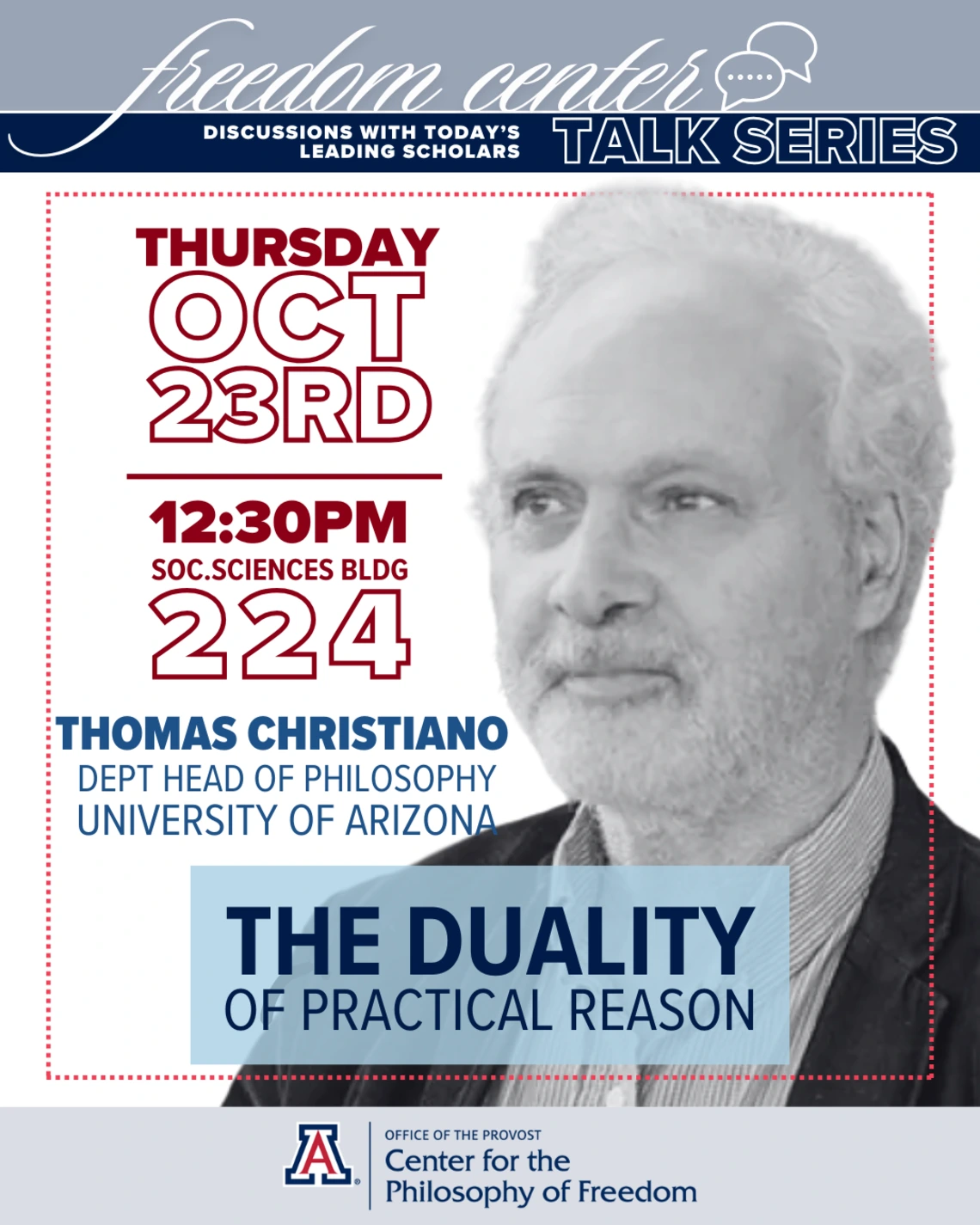
Join us for an engaging talk by Thomas Christiano. This event will take place in Social Sciences 224 from 12:30 PM to 1:30 PM. Don’t miss this opportunity to gain valuable insights and participate in a stimulating discussion!
Location
Social Sciences Building, Room 224
1145 E South Campus Drive
Tucson, Arizona 85721
Online Attendance
Title
The Duality of Practical Reason
Abstract
In this paper it is argued that practical reason has two fundamentally different components: individualistic reasons for action (which are reasons connected with actions that make a significant moral or prudential difference) and non-individualistic reasons for actions (reasons for actions that do not make a significant difference by themselves but are such that a large collection of such actions make a significant difference). The thesis is similar in some respects to Sidgwick’s dualism of practical reason, though individualistic reasons need not be self-interested and non-individualistic reasons need not be moral or altruistic. Three arguments are proposed for non-individualistic reasons for action: one that is directly connected to the existence of collective goods; a second that connects non-individualistic reasons to individual plans of action in which no individual action makes a significant difference; a third argument showing that various commonly accepted principles such as fair play in large number cases presuppose non-individualistic reasons for action.
The paper then discusses how non-individualistic reasons can trump various individualistic reasons for action. The question is how to produce a kind of obligation to act non-individualistically as might be the case in a duty to vote and in the case of the duty to obey the law.
Finally, discussion is devoted to some of the deep puzzles of non-individualistic reasons such as their tendency to generate sorites problems and the truly fundamental question as to how non-individualistic reasons interact with individualistic reasons.
Bio
Tom Christiano is a Professor of Philosophy at the University of Arizona. His teaching and research focus on moral and political philosophy with emphases on democratic theory, distributive justice, and global justice.